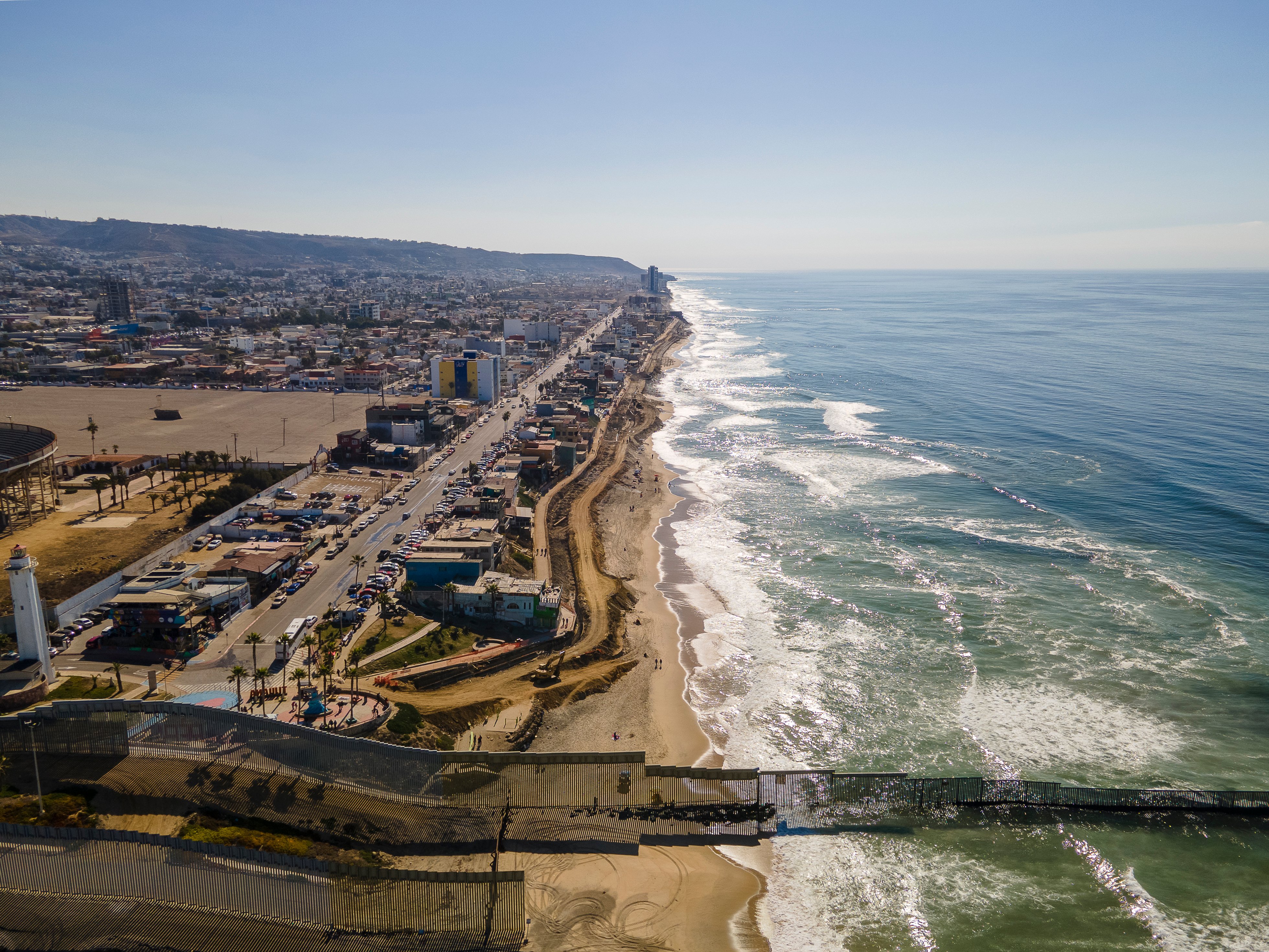
Cover photo: Veriditas Rising and Surfrider Foundation
The Tijuana River Watershed is a strikingly beautiful and deeply meaningful place for communities on both sides of the Mexico/U.S. border. It provides critical habitat to countless species and is the largest remaining coastal wetland in Southern California. Yet billions of gallons of raw sewage, industrial waste, contaminated stormwater, and trash have flowed through the Tijuana River Watershed for decades, crossing the U.S./Mexico border, and polluting the Tijuana River Valley and Pacific Ocean. This ongoing environmental catastrophe has devastated coastal communities in southern San Diego County and northern Baja, forcing prolonged beach closures, harming public health, damaging sensitive ecosystems, and threatening local businesses and economies.
The impacts extend far beyond the beach. Communities near the Tijuana River are exposed to contaminated water and air, including harmful gases released from polluted waterways. Research from University of California, San Diego and San Diego State University has demonstrated that pollution from the river can become airborne, raising serious concerns for residents, workers, students and visitors who may be exposed simply by going about their daily lives. The Tijuana River Estuary, a vital coastal wetland habitat, also continues to suffer from decades of sewage, industrial waste, trash, and sediment entering the watershed.
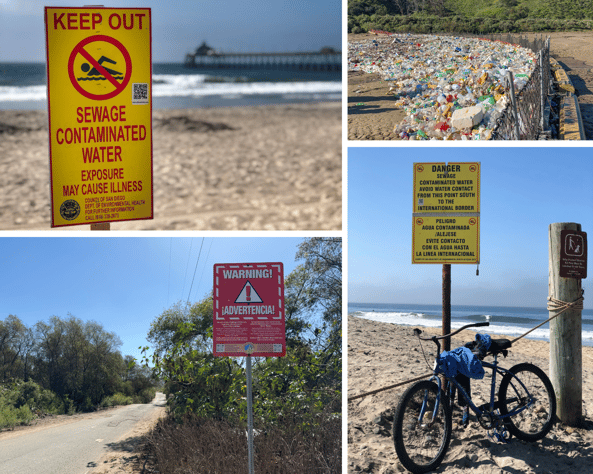
Photos from Surfrider Foundation: Signs warning the public of health risk from exposure to toxic water and air and trash boom in the Tijuana River Valley that collects over 50 tons of trash every year
Despite years of advocacy, litigation, and significant government investment, the infrastructure needed to capture and treat cross-border pollution remains inadequate. The U.S. Environmental Protection Agency has developed a Comprehensive Infrastructure Solution to address the crisis, and work is underway on critical wastewater infrastructure projects. However, significant funding gaps remain, particularly for the construction, operation, and long-term maintenance of the systems needed to stop polluted flows and protect impacted communities.
Even though transboundary pollution in the Tijuana River Watershed remains one of the most significant public health crises in the Western Hemisphere, there is still no continuous, dedicated source of funding to address it. Each year, Surfrider Foundation and our partners devote significant time and resources to advocating for funding from local, state, and federal leaders. We are often competing with other important interests and priorities while navigating lengthy bureaucratic processes that make it difficult to secure the sustained investment needed to move the needle on this crisis.
Enter Measure B, the San Diego County Health & Safety Act, which is on the November 3, 2026 ballot. This citizen-led initiative proposes a countywide half-cent sales tax to support healthcare, childcare, food security, public safety, and solutions to the Tijuana River pollution crisis. If approved, the measure is estimated to generate approximately $400–450 million annually, with 22.5% dedicated to Tijuana River pollution cleanup and response efforts. That’s up to $90 million per year to address the public health crisis in the Tijuana River Watershed.
The funding could support critical wastewater infrastructure, trash and sediment removal, habitat restoration, water quality improvements and health-related responses. A dedicated local funding source would help advance projects needed to capture and treat polluted flows, complementing investments already made by federal, state, and binational partners. Just as importantly, it would provide ongoing resources to operate and maintain both new and existing infrastructure. Without sustained funding, critical projects may be delayed or left unfinished, and the effectiveness of completed projects could be undermined if the resources needed to maintain them are not available. Ultimately, protecting people and ecosystems requires not only building the necessary infrastructure, but ensuring it continues to function effectively over time.
For Surfrider Foundation, this investment is directly connected to our longstanding work through the Clean Border Water Now Program. For nearly three decades, Surfrider has worked alongside impacted communities, scientists, environmental organizations, and government partners to advocate for clean water and lasting solutions to cross-border pollution. Our efforts have included community engagement, coalition-building, legal action, water quality monitoring, and advocacy at all levels of government for the comprehensive infrastructure improvements needed to stop the flow of pollution. We know that addressing this crisis necessitates more than temporary fixes. It takes sustained investment, government accountability, and prioritizing public health and the environment for generations to come.
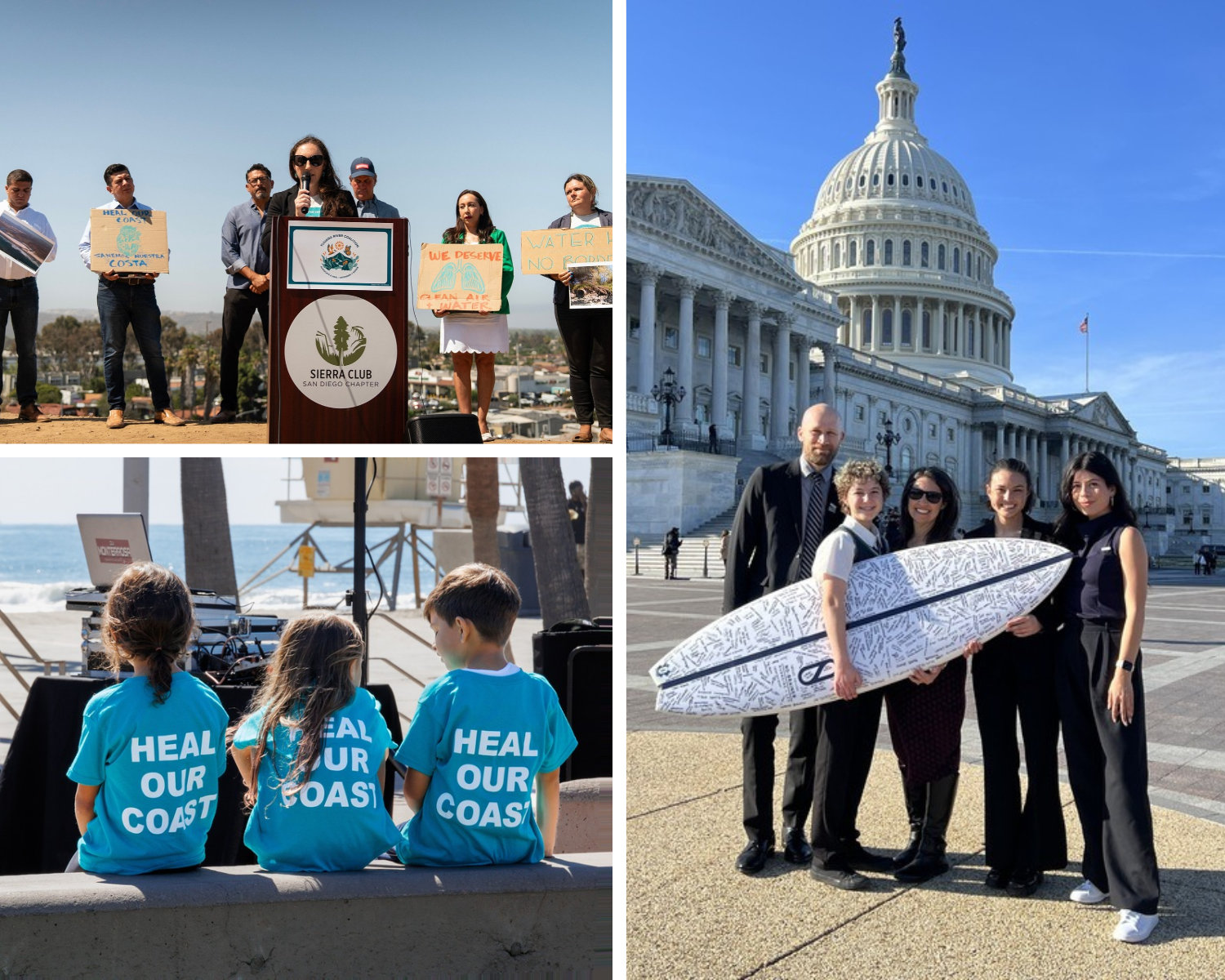 Top left photo from Sierra Club San Diego Chapter: 2026 press conference with Tijuana River Coalition advocating for the addition of Tijuana River protections in the Us/Mexico/Canada free trade agreement
Bottom left photo from Lisa Kaczmarczyk: 2024 Unite to Heal Our Coast event
Right photo from Surfrider Foundation: Surfrider goes to Washington DC to advocate for solutions to the Tijuana River pollution crisis during annual Coastal Recreation Hill Day in 2023
Surfrider Foundation endorses Measure B because of its commitment to providing dedicated, long-term funding to address the Tijuana River pollution crisis and support healthier, safer communities. While no single measure will solve every aspect of this complex international problem, establishing a sustainable local funding source would help advance the infrastructure solutions our region urgently needs. Continued federal leadership and cooperation between the United States and Mexico will remain essential to achieving lasting results.
The future of our coastal communities, clean water, and healthy ecosystems depends on our ability to address this pollution crisis. Measure B presents an opportunity for San Diego County to invest in a healthier future—one where residents can go to school, work, enjoy their beaches, and spend time outdoors without the threat of exposure to contaminated air and water in the Tijuana River Watershed.
Surfrider Foundation urges San Diego County voters to vote YES on Measure B.
Other Ways to Contribute:
- Follow us on social media for regular updates: @cleanborderwaternow
- Sign up for our mailing list
- Check out our monthly Tijuana Watershed Speaker Series
- Donate to our Clean Border Water Now program to help us continue this work

Photo: Veriditas Rising
 Sarah manages the Clean Border Water Now program, based in San Diego, CA, on the unceded homelands of the Kumeyaay people. She has a B.S. in Marine Biology from UC Santa Cruz, and master's degrees from American University in Washington, D.C., and University for Peace in Costa Rica in Natural Resources and Sustainable Development with a focus on transboundary water cooperation.